Showing posts with label opinion. Show all posts

Saturday, September 10, 2022

Beginnings, endings and inbetweens

Students are back and my neighbourhood is surprisingly quiet. I keep waiting for the other shoe to drop. What, did they all mature over the summer? I saw one guy walking up the street with a bong, and later a couple of guys carrying 12-packs of … water! Maybe they all gave up booze? I don't know. I am enjoying the peace, for however long it lasts.

The dry sunny weather continues on and on. I've never had to water my garden in September before. We have water restrictions right now so it is a good thing I have a rain barrel. The water restrictions are not due to lack of water but rather a broken part in the reservoir that needs to be replaced, but is caught up in supply chain issues with no ETA.

I started a Tai Chi class. I really am hoping this is a level of activity I can tolerate. My Fitbit tells me that the first class hardly raised my heartrate at all, a good sign. But the following two days I've been pretty much confined to home due to dizziness, not a good sign. The instructor of the class is really good, plus he has volunteer helpers—more experienced students—to help guide us. There's one woman in the class who I am pretty sure has dementia, she sticks pretty close to her husband and only vaguely follows the instructions. But nobody says anything about that, the class is very inclusive. I don't have to pay for the class until I've completed two sessions, to know whether it suits me or not. At this point the jury is out. I really enjoyed it, but spending two days after virtually bedridden is a little disconcerting.

Shortly after I got out of my Tai Chi class I saw the news that the Queen had died. It feels almost like a death in the family. I know that some people disapprove of the Monarchy but I for one do not. She has been a source of stability for a very long time. When I was three years old I went with all my extended family to see her when she visited Toronto back in the day. Since our house was closest to the parade route, the family gathered there afterward. I remember the gathering but not so much the Princess (she wasn't Queen yet), just that it was a momentous occasion.

I liked living in a country with a Queen, I like that Canada is part of a larger community, the British Commonwealth. I realize that the Commonwealth is just the old British Empire with a new name and that the British Empire was a great colonial power that did a lot of damage in many parts of the world including here, damage that people are still having to deal with. But being part of a larger whole, for better or for worse, and having a long history, also for better or for worse, seems to me a good thing in the long haul. And I'd rather be part of the British Commonwealth than the Russian Empire.

Anyway, I miss Queen Elizabeth II, the end of an era that lasted almost my whole life. I think she did a very good job of it. It will be strange to have a King rather than a Queen, but I hope he does well too. I read something about him, how he was in the habit of espousing weird ideas that people made fun of him for. You, know, organic food, the environment, that sort of thing. Now he looks a little prescient.

Sunday, August 15, 2021

Election, election, election...

So, as I type, PM Trudeau is chatting with Gov-Gen Mary Simon about calling an election in the fall. Here in Nova Scotia we are set to vote on Tuesday, a provincial government election. Back-to-back elections just annoys me no end.

I was listening to a woman on the radio talking about the current promise of affordable childcare, which apparently is still in negotiation with the various provincial governments. This woman is tired of waiting (she has two daycare-age kids) and in any case finds daycare totally unaffordable. The waitlists for daycare spots were bad enough before the pandemic but now are so bad that it really doesn't matter how much it costs, she can't get it anyway. Which all reminded me of the promises made by politicians when my kids were preschoolers, and now they are in their 40s and 50s. I am so bloody tired of listening to it.

Childcare is important, so is climate change, affordable housing, social supports for the poor, the homeless, the disabled, the sick, the old, and of course how we manage the pandemic (fourth wave?!?). Then there's LGBTQ issues, policing problems, discrimination, indigenous issues, blah blah blah. Not to mention wars and earthquakes and all the rest of that 'End Times' stuff.

A short while ago I happened to run into an anti-vaxx anti-mask fanatic. We had a very polite friendly conversation about our positions on the Covid vaccine but I came away thinking O, M, G. And elections just accentuate all that, all the diverse opinions from compassionate and rational to the fanatical and insane are aired out and shouted out and I am so tired of it. I feel like it's useless to vote, it's useless to listen to all the promises being made because all it does is make me sad: a world we could have had but probably now never will.

On the radio Trudeau has emerged from his chat and is saying stuff about how we need to discuss all these issues and make up our minds. I didn't hear a date yet but I'm guessing middle to end of September.

O, M, G.

Today I was daydreaming about a good old fashioned tyrant, you know, kind of like what they have in China. Somebody who said, Enough talk, here's what's going to happen. I suppose I should keep quiet about that, be careful what you wish for you might just get it, and all that. But still...

Sigh.

Thursday, June 3, 2021

Genocide

I listened to discussion of the mass burial of children at a Kamloops residential school on CBC Radio's The Current yesterday and it really hit home. The pivotal moment for me was when one speaker said that they weren't really schools they were detention centres; children were held there until they were broken in or had died in the process. The schooling they received did not do them any favours or prepare them for the world they were to be released into. They lost their parents, they lost their communities, their language, their native skills, their culture. And it goes without saying that their parents lost their kids and their own futures. I can't imagine the pain they felt.

The residential school system was started by our dear founding father, Sir John A, to "assimilate" the native peoples of our new country into colonial culture. It destroyed them. The Americans had the Indian Wars, we had the residential schools. It was a kind of genocide that we politely refer to as cultural genocide. The word "cultural" makes it seem less violent, less murderous than the real thing, but it's not. Nowadays we decry the separation of children from their parents at the southern American border, this was far more horrific in that it went on for generations. It started soon after Confederation (1867) and the last school was closed in 1996. Those children were really never released, the ones that made it back to their home communities were forever cut off from them by virtue of their lost abilities to communicate with their families or even support themselves. Not to mention the emotional trauma they survived but never resolved.

Until relatively recently we all approved of violence toward children in the name of education, I was lucky enough to go to an elementary school where the principal at the time was the first in Toronto to ban corporal punishment of pupils, just the year before I started there. So it would not have been unusual to use violence to "educate" the children of residential schools. But those kids did not get to go home at the end of the day, they lived day in and day out in the school with the perpetrators of the violence. When those children died, they simply disappeared from their family's lives, very few were even informed of the death of their child. CBC has published the names of all the children known to have died at those schools, but those names are many fewer than the number who actually died and were buried there.

The schools were run mostly by religious groups, predominantly Roman Catholic monks, priests and nuns, but some Protestant religious groups were involved also. The Roman Catholic Church has consistently refused to release the written records of those schools to anyone, not the families of the children, not the First Nations communities, not even the Canadian government. No one knows the true extent of the horror. First Nations are determined to use ground-penetrating radar at all residential school sites, whether publicly or privately owned, to find the bodies of their lost children.

My mind just boggles at the damage done in the name of Canadian civilization. This is a horror that First Nations have known all along but the rest of us have not taken seriously. The result of the residential school system decimation of First Nation culture is right up there with the Jewish Holocaust of World War II, in  my opinion. Maybe worse. I remember that when I was a teenager a representative of the South African government told a group of us that we were in no position to criticize his government's treatment of the Black peoples of his country, after all apartheid was based on the Indian reservation system of Canada. And China has admonished our government for criticizing the Chinese government treatment of the Uighurs, after all we did the same to our First Nations.

Presently over a hundred First Nations are suing the Canadian government for reparations. This is an action that has been in the works for awhile, but in light of what was discovered in Kamloops has suddenly gained some traction. My grandson goes to a university named for the man who essentially designed the residential school system, my grandson and many of his peers now refer to that school as X University. Commemoration of the founders of our great nation and the enablers of "cultural" genocide is hard to stomach.

Tuesday, May 11, 2021

Conspiracy theory and other news


Yesterday was a busy day for me. I was scheduled to pick up the truck in the afternoon and I had to go to the bank in the morning to get the cash. My bank is not in my town, I had to go down the road, and since I was there anyway I did a bit of 'essential' shopping on the way.

Picking up the truck involved getting a ride with J to the truck owner's house and then hanging out for an hour or so just yakking. It was a nice sunny day so hanging out was not so bad except that I really had to go to the bathroom and was thirsty as all get out. J is diabetic and was overdue for his pills so we both had 'personal problems' being there, but I guess it was part of the deal. The truck owner loves the truck and is very reluctant to see it leave, but he needs the money. J told me that the only reason he sold it to me was because J assured him I would take care of it the same way he did. That could be just a line but I believe J, I felt the same way about my old S10.

When I got home J came by after taking care of his own issues and installed the radio in the truck. It never did get an oil change so I scheduled one for next week. I called around about insurance, I was thinking of going with CAA because they offer a cheaper price than my current insurance company, but I spent so much time on hold just trying to get a quote that I thought better of it. The extra cost is worth it to have a local broker who answers the phone without resorting to a complicated menu of options, not to mention lengthy on hold times.


So now I have two vehicles in the driveway and am thinking of keeping both, one for summer and one for winter. The underside of the truck is in pristine condition, it would be a shame to expose it to Nova Scotia road salt.


It stays light so late now that after supper there were still hours of daylight left in the day and I hadn't gotten much exercise so I went for a walk. I visited my Bubble buddies about a 20 minute walk away and sat in their backyard watching their new puppy at play. The puppy is much bolder now and her teeth are needle sharp. She definitely needs puppy training but nothing is open at the moment. The vet also recommends waiting until all her vaccinations are in effect before she socializes with other dogs. Same as people.

Then my friend said something surprising. He mentioned reading an article about how the SARS-Cov2 virus (aka Covid-19 virus) is more than likely to be lab-generated. Among all us anti-Trump types that is a positively heretical thing to say, and I asked him what the evidence was. He said he was not science-oriented so he couldn't really say but he thought if I looked it up I might be able to understand the argument since I have a science background. He couldn't remember off hand what the article was and I didn't want to go in his house to see his computer since I have spent the last few days hanging out with non-Bubble friends. So I went home to look it up.

Well, the jury is still out, but when Trump said the virus might have originated in a Chinese lab, he definitely had access to suggestive information. He just kind of shot his mouth off about that without naming sources or verifiable facts. Because, if true, then American military and scientific organizations are also implicated, not just Chinese. Also, the PCR test used to identify Covid infections came so fast after the pandemic started (like, about a month) and is so specific and was so quickly peer-reviewed and published, that the origins of the test are also in question.

Anyway, I found a couple of articles in two different places that have describe such a scenario. The sources are not rock-solid virtuous tellers of the truth, but they are interesting and suggestive. I provide links below, look them up, look up the authors and the websites and make your own decisions. These days that's about all you can do.

We are all mostly aware that 'the military-scientific complexes' of several (if not many) countries engage in biological terrorism research. With the ability to not only sequence genomes of many different organisms including viruses and the technology to modify such genomes, scientists now can and do create genetically modified organisms (GMO). All over the world there are labs for doing so, some benign and some not so benign. Depending on how dangerous the research is considered to be, biological labs have different levels of lab safety protocols in place, ranging from BSL1 to BSL4. BSL4 is the most restrictive and therefore the most protective; the chances of an accident happening in a lab certified at BSL4 are very small.

However.

Scientists are human, every last one of them. One of the things we humans do is cut corners. BSL4 is uncomfortable and slows your work down by a lot. It involves wearing spacesuit type coverings and going through elaborate cleaning rituals and being tethered by air tubes and wearing gloves that make handling things difficult and headgear that make seeing things difficult. Not to mention hot and sweaty and awkward. There have been accidental releases of pathogenic viruses from BSL4 labs ever since that kind of research started, including a smallpox release that resulted in a number of illnesses and deaths. For the most part these accidental releases have been covered up and the resulting damage contained.

There is a type of research called Gain of Function, which involves adding a pathogenic function to an otherwise relatively benign organism. This means that, say, a coronavirus that is incapable of infecting humans, or causes only mild illness, is genetically modified to be lethally infectious and contagious in humans. The virus is weaponized. Once the deadly virus has been created the scientists then work on a vaccine for it. President Obama banned such research in the US, however there is an escape clause in the ban that allows some research to continue to be funded, particularly by the Pentagon.

So, what if such Gain of Function research was being done in a lab far far away but partially funded by an American organization interested in such things, but due to the BSL4 protocols being so onerous, there were lapses. What if that lab was, as many of these labs are, located in a densely populated city at the centre of a highly active air transportation network?

On the other hand, what would it take to get a virus from a bat cave hundreds of kilometers away to the city where the illness first occurred in humans? Especially since so far no one has yet to isolate SARS-Cov2 in the wild? Yes, SARS-Cov2 is very similar to coronaviruses that infect those bats but are not infectious or contagious in humans. But the necessary evolution from a bat virus to a human virus is complicated, at least as complicated as creating a pathogenic virus in a lab and allowing it to escape into the local human population.

SARS-Cov2 contains a small structure called a furin cleavage site in the spike on its outer coat that is the means of breaking through human cell membranes. Without the furin cleavage site the virus would be harmless to humans. The furin cleavage site on the SARS-Cov2 virus is fairly unique in its genomic structure, it is not seen in any coronaviruses related to SARS-Cov2. However other forms of furin cleavage sites are seen in viruses that are contagious and infectious in humans. Scientists have the ability with CRISPR technology to create and insert a furin cleavage site into a coronavirus. It could have evolved naturally, but so far there is no evidence of that.

China has sealed the lab records of the scientist at the head of such research in the BSL4 lab located in Wuhan, so we will never know for sure. Chinese scientists and officials have been cooperative to a certain extent, but vigourously deny culpability. Many other scientists and public figures have denied categorically that this happened, or could have happened. Because, if it were known to have happened, then public outrage would be pretty darn, well, outrageous.

Trump may not have understood the scientific or political details, let alone the need for secrecy, but he would have had access to this kind of information. He was inclined to say publicly whatever he thought played to his electoral base, and conspiracy theories definitely play to his base.

My sources are linked below. The author of the first link has a checkered past but is not altogether unreliable. I have not found any critical reviews of this particular article, but since it is relatively recent that may come. It is long and technical and far more specific and detailed than I have been, so read at your own risk:

https://nicholaswade.medium.com/origin-of-covid-following-the-clues-6f03564c038

The following link gets a middling review as reliable. Again, read at your own risk:

https://www.independentsciencenews.org/news/peter-daszaks-ecohealth-alliance-has-hidden-almost-40-million-in-pentagon-funding/

Monday, April 12, 2021

Thoughts from my weekend of reading


I am reading The Splendid and the Vile by Eric Larsen. It is a very large book (over 500 pages fine print, no pictures) about one year in the life of Winston Churchill, spring of 1940 to spring of 1941. As Mr Larsen says, this is the year that Churchill became Churchill, the bulldog of a man we think we know. Very detailled, quite engrossing. Mr Larsen draws on several personal diaries of the time, notably John Colville's (The Fringes of Power, 1985), who was Churchill's personal secretary and privy to most of Churchill's political and personal life. Of course, a book set in that period of time cannot ignore The Battle of Britain or any other notable events of the time, up to and including the bombing of Pearl Harbor. It is a fascinating view into that period of World War II.

Something that interests me is how Adolf Hitler is portrayed, both in this book and elsewhere. When we think of Churchill and Hitler, we conjure up stereotypical images of heroes and villains, believing one to be All Good and the other to be All Evil. I've certainly heard evidence that Churchill was not entirely the stereotypical hero, plenty of people have good reason to be disturbed by his role in hiistory. In this book Larsen only focuses on Churchill's moment of heroic glory, but he does not deny Churchill's lesser qualities. But what of Hitler?

In videos I've seen of Hitler's famous speeches, he appears as a fervent madman. Yet in this book Larsen quotes reporters who attended such speeches as to how genuine and convincing Hitler seemed. He was a master of rhetoric, not in the fervent madman sense but in his command of the stage, his intuitive sense of timing and his ability to convey facts and emotions in a convincing manner. It is hard to square the two impressions. 

I think we make a mistake in portraying the man as solely an evil madman. He was the right man at the right time. Germans were very much hurt and suffering from the Treaty of Versailles agreed upon at the end of World War I, he addressed that suffering and offered a righteous solution to it that Germans could embrace. He of course blamed 'The Jews' as the ultimate source of German suffering, but he was not so different from many others who harboured that prejudice at that time. The fate of the St. Louis is a case in point. When other countries declared war on Germany, it was not out of outrage at the Nazi persecution and murder of Jews, but rather the very real fear that Germany under Hitler was capable of conquering all of Europe and then proceeding to conquer North America.

Like Churchill, Hitler was a great leader, he encouraged and mobilized Germans to address their social and economic distress, he made them proud to be Germans. My opinion is that we should look on Hitler as we do Churchill, a man of both good and bad qualities. If we think of him as a madman then the damage that he did is considered almost impossible to repeat, after all it was done by a madman and a psychopath and we have mechanisms in place to deal with such people. 

If on the other hand we realize that he was actually an ordinary man who managed to get his hands on the levers of power, then we also realize that it could happen again, it is not so far fetched. He did after all do some good for some people, he did care about the fate of his people and much of his motivation was not out of hate but out of desire for revenge for very real hurts. A lot of people could fill those boots, it is not an extraordinary circumstance.

Monday, April 5, 2021

Easter, happy or otherwise

Interesting weekend, although nothing happened and I didn't go anywhere except the grocery store on Saturday. I commented to the greeter at the store, a young man, about the length of the line up to get in and he responded that his mother always planned well ahead for Easter so that she didn't have to shop between Good Friday and Easter Sunday. I said, yeah, good plan, although sometimes there's a last minute item you absolutely have to have right away (for me it was a sweet potato; I know, not really a must-have but in my mind it was), he agreed and we laughed. So that was pretty much all the excitement for the long weekend.

~ ~ ~ ~ ~ ~

Hapi keeps changing her schedule, each change involves more sleep time, she just rearranges her day to accommodate the increased amount of sleep time. So these days she sleeps from supper time to noon or later, has a midday or early afternoon meal and then a walk and then her late afternoon supper. She does some 'sundowning' after her supper, I try to grin and bear it although sometimes I lose my temper when it goes on and on and on. Her bedding is stinky which means my bedroom is stinky.

I used to have scent-free laundry detergent but the last purchase was excessively scented. Since I hang my laundry to dry indoors, well, between overly-scented laundry detergent and stinky dog, it's quite overwhelming. Let's just say that I can't wait till the weather improves enough to hang laundry outdoors. I may have to cave and toss the heavily scented stuff for some expensive unscented detergent.

~ ~ ~ ~ ~ ~

I've been doing some online reading about the little bit of research done on long Covid. Emphasis on 'little bit'. This morning I completed a detailed questionnaire about my own experience for a research survey on long Covid, being run by some 'citizen scientists' (i.e., not degreed medical researchers but interested citizens with research skills) out of the UK. It took more than an hour to complete, fortunately they warned in advance that it was long. The weather is crappy and the dog is asleep so I didn't have anything more productive to do.

What I think is interesting is that 'patients' have lost patience with doctors and are taking things into their own hands. When AIDS first reared its ugly head no bona fide medical scientists gave it credence; it took activism on the part of the patients to push them into doing the research. Now there is a diagnosis and a treatment but no cure. When Chronic Fatigue Syndrome appeared, same thing. Even today there is resistance to that diagnosis and no agreed upon treatment. There's not even an agreed upon definition of CFS (several 'official' ones but no solid agreement). So now, long Covid is going through the same process, trying to get medical people to recognize it and research possible treatments.

But this time it's different. This time the patients are doing the research. Thanks to social media and more open access to scientific research papers, the people who have the disease are doing the work. Some scientists came up with the name 'post Covid viral syndrome' but that didn't stick, 'long Covid'—a name first used by a person with the disease on Twitter (#longCovid)—did. They call themselves 'long haulers' and the scientific research community has kind of been forced to use the same terminology. There's still a long way to go, but I think it is a step in the right direction. One of the scientific papers I read last night commented that scientists need to consult with the real experts on the disease, namely the people who have it. You'd never have seen a scientist saying a thing like that even a year ago.

I think there is a sea change in people's attitudes toward complex disease syndromes. It used to be you had to wait for some degreed medical researchers to recognize it, devise a means for diagnosis and then research possible treatments. Now, people who have these unrecognized complex disease syndromes don't want to wait for degreed scientists to pay attention, nor do they want to wait for funding from official government sources. Covid has made it abundantly clear how a bunch of sick people can gum up an economy, paying attention to young sick people is starting to be a thing. [agism still works against old sick people, it'll be a while before that changes, in my opinion]

The UK seems to be making headway with this and I expect the US is too. They are further along in Covid infection rates and vaccination rates than we are here in Canada so they have more to work with. More manifestation of the disease, more recognition of its existence, more research work on it.

Monday, February 8, 2021

Covid politics

I've been doing a lot of reading about the Covid-19 vaccines and their development, and now that they are in the beginning stages of distribution I've been reading about that; mainly about how the distribution of initial doses is prioritized when supplies are very limited. So, the scientific literature shows that the risk of death rises dramatically with age, while the risk of contagion and spread is principally among the young and mobile. The issue is, which is more important, stopping mortality or stopping contagion? 

In general, scientists are coming down on the side of stopping mortality. This means getting the vaccine to the people whose risk of death is highest. Various studies have looked at how much comorbidities impact the risk of death and whether people who have COPD or diabetes or hypertension are more at risk than people of "advanced age". So far the research is showing that advanced age trumps all. Specifically, age beyond 70 years.

Most published studies, perhaps all, rank ages in decades: 50-59, 60-69, 70-79, 80+. I have yet to see a study that uses different age ranges (55-64, 65-74, 75-84, etc), so whether the risk of death rises dramatically between 74 and 75 is undetermined in the published literature. 75 years old is just not a critical marker of anything.

And yet. Looking at the immunization priorities across our country and also in some other countries (UK, USA), the age of 75 is frequently used as a cut-off point. My guess is that it's political. There is the original issue of whether stopping deaths or stopping spread is more important, and there are groups with some political power who want to justify going to the front of the line. Politicians are trying to compromise; if you move one group to the front then you have to move another group to the rear.

So, if you start looking at stopping the spread, who become the priority groups? Well, kids have been ruled out on this one, nobody ranks kids as being the most important group. Likewise for teenagers. Even though the most mobile groups in our modern society are probably school kids and teenagers. So healthcare workers go to the top of the list, especially if they are working with old people. Then a bun fight breaks out; if you're going to protect this healthcare group then why not that one? Who has more power to sway the case, low-paid personal care workers, better-paid and organized trained nurses, or highly trained and politically powerful doctors? And if doctors go to the front of the line, why not dentists? Pharmacists? And of course their employees the dental hygienists and pharmacy technicians…

When the vaccine distribution first started in December, the media loved to display photos of young photogenic healthcare workers getting their jab. God forbid we show an old lady's flabby arm being jabbed. Old women are better viewed masked and gowned behind the thick plate glass of nursing home windows.

Different provinces have worked out different compromises and timelines. Here in Nova Scotia, my age group 70-74, goes to the back of line. People over 75, people in nursing homes, anyone doing anything in healthcare, truckers, meat packers and host of others ("food supply security") take precedence over everyone under the age of 75 who is not in any of those special categories or not in a long term care facility.

Furthermore, looking at the rate at which vaccinations are being distributed, Nova Scotia ranks lowest of all provinces and territories. Currently the average rate is 2.4% (roughly) for the entire country and 1.3% for Nova Scotia (as of today, on the CTV News Covid vaccine tracker). Our phases of distribution (1, 2, and 3) are considerably later than any other province. I read one source that said that Phase 3 (my phase) won't happen until the fall, in spite of PM Trudeau's assurance that everyone who wants it will be vaccinated by September. [I accidentally transposed the 'r' and the first 'u' in his name and briefly considered leaving it that way ;-)]

I am pretty sure my sons living in other provinces will get vaccinated long before I do. One of my sons is an aerial fire fighter, I am pretty sure the provincial government he will be working for will make damn certain he is designated an essential worker and he will get vaccinated before his training in the spring. The other two live in Covid hot spots where vaccine is way more available than in my little province that worked damn hard to contain and keep out the virus.

It's all politics and who holds power to sway politicians.

Friday, January 1, 2021

Loneliness II


I'm coming back to a subject I touched on earlier: loneliness. I've been doing a lot of reading on the subject and trying to formulate this post in my head. Principally, I've been reading Loneliness (2008) by John Cacioppo and Lonely (2010) by Emily White. Cacioppo is a social neuroscientist (a field of research that he founded) who describes the results of his research on the subject; White is a Canadian writer who describes her experience of loneliness in the context of that research. I found White's book the more interesting of the two simply because of its very personal nature, but Cacioppo's book is interesting because of the objective science he brings to the subject. Both writers refer to another scientist, Robert Weiss, who wrote about loneliness in the 1970s; White calls Weiss's book the Bible on Loneliness. He overturned some prevailing opinions on loneliness through his meticulous research studies. Unfortunately, those prevailing opinions are still very much in vogue.

Humans are an 'obligatorily gregarious' species, which means we need to live in groups in order to survive. We are biologically determined by our need for others in that being alone is not only dangerous but bad for our health. Some mammals are adapted to the single life (orang-utans and bears for example) and others are not (chimpanzees and baboons). The health effects are numerous and borne out by research. You die younger. It compromises your immune system and sets you up for cardiac and neurological problems. 

Cacioppo suggests thinking of the role of loneliness in our lives this way: humans first evolved in a relatively harsh environment (the African savannah) and going it alone was simply not an option for survival. But if you belong to a tribe and for some reason you are ostracized and kicked out of that tribe, then you are in danger. So there you are, out on the vast savannah all alone, and you see on the horizon another tribe of humans approaching. At first you might think, Oh good, I can just join up with them and everything will be fine again. But then you realize that it might not be that simple, they would see you as The Competition for limited resources, and you are only one while they are many. Maybe approaching them is not such a good idea, maybe hiding is the better option. You are in a difficult position, potentially risking death by staying alone or almost certainly risking death by attempting to connect with strangers.

That is how loneliness operates. You don't really want to be alone and it is ultimately bad for your health, but there are strong forces within you cautioning you to avoid contact with others. Unlike depression, it's not something you can bootstrap yourself out of. It's also not age-dependent, it's not strictly a problem of old age, although we like to characterize it that way. And it is becoming more pervasive across all ages. Just in the past few decades statistical surveys have shown that it has and is growing immensely as a serious social problem. But the stigma attached to it makes it very difficult to deal with socially. It is far easier to admit to being depressed than to admit to being lonely.


Until relatively recently we treated depression as a personal defect too, people didn't want to admit to it because of the stigma attached. But now we see depression not as a personal shortcoming but as a kind of illness that can be treated with various therapies, whether prescribed by a doctor or psychologist or self-administered. Loneliness still very much has a stigma attached to it, lonely people are seen as somehow defective, perhaps lacking in social skills, basically unlikeable, or deliberately self-isolating for wrongheaded reasons. The lonely person herself will wonder what is wrong with her that she can't make friends, enjoy an active social life, or attract a lover or mate. There are no proven treatments for it, a doctor or therapist won't diagnose it nor recommend treatment for it, other than to get out there and socialize. See the alone-on-the-savannah story above.

Weiss was the first researcher to show that lonely people do in fact have entirely adequate social skills and are just as attractive as anyone else. Many lonely people do have lovers and mates, even active social lives. He suggested that there were two kinds of loneliness, social and emotional. Social loneliness is the lack of a satisfying or adequate social network, emotional loneliness is the lack of intimate contact with at least one other person. Cacioppo goes on to show that there is a further breakdown into longterm chronic loneliness and shortterm circumstantial loneliness. A significant majority of longterm loneliness is triggered by parental divorce or separation. A person grows up experiencing a deep insecurity about relationships of trust that they can never quite shake.

There is a genetic component as well, some people have a higher need for social interaction than others, and that appears to be genetically determined. That doesn't mean that those people are more lonely, just that they may be predisposed to loneliness if that need is not met.

White ends her book with the development of a personal loving relationship in her life. She says that her own efforts to deal with and end her loneliness did not help, it was the sheer luck of finding someone to love and be loved by. Both White and Cacioppo contend that loneliness is a big social issue and really only has social solutions, it takes other people to bring the lonely person back into social connection. White describes some organizational efforts in that direction, loneliness reduction programs that attempt to bring lonely individuals into the fold. Not simply with other lonely people, but other lonely people that they have commonalities with that will ease the development of social connectedness.

White wrote a second book Count Me In (2015) that follows up on her life after the period described in the first book. In the second book she is single again after the love relationship of the first book ended, and describes her concerted efforts to reconnect socially. I've read some but not all of it so won't comment now about her conclusions.


Given the rise of loneliness in our modern culture and the past year of pandemic isolation, I can't help but believe that social loneliness may have reached a tipping point. I see in the news that mental health and isolation are now seen as serious side effects of this pandemic. How we will address that is going to be interesting.

Sometime after I moved back to Nova Scotia someone suggested I join the local Newcomers Club (part of a national organization). At the time I wasn't really looking for ways to engage socially, I already had an existing network of old friends here. However my membership in the club has proven immensely beneficial, I now count people I have met through Newcomers as my major social network. I still have previous friends and acquaintances, but Newcomers is a way to have a constant pool of new friends to draw on and social activities to participate in. The structure of the club is almost tailor-made to address potential loneliness. You join at a monthly meeting and sign up for any 'interest groups' that look promising to you. If you don't see your particular interest represented then you can create a group. We have groups for eating together, hiking, cycling, needlecrafts, book reading, games, discussion and social outings. People who are new in town see the club as a way to kickstart a social life here. 

This year the membership fee has been waived and several of the groups are on hiatus. The outdoors groups still meet (outdoors) and a couple of other groups have gone to Zoom. Admittedly our club skews to older people, young people don't often stay when they see all the grey hair around. Newcomers Clubs in other locations are more or less successful, have more or less restrictions on membership. One club is restricted to women only, another boots you out after a specified number of years (three I think). Ours is pretty loosey-goosey, we don't even require you to be new in town or to live within the town when you join. And you can stay as long as your heart desires, no pressure.

Wednesday, December 9, 2020

Loneliness and Depression

OK, downer of a topic, but here goes. First go read this. Or, you can search for John Cacioppo on Youtube; he has a few rather long videos there, reading the article is quicker.

I'm not going to recap it for you, so go read it if you're still interested in this post. I understand if you're not, I don't think I would be either. Were it not for circumstances.

This morning I consulted Dr. Google on what the difference is between depression and loneliness. I didn't get a clear answer, I think it might be like telling the difference between a cold, the flu and Covid. There's a lot of technical info about the differences (different viruses, etc), but when you look at the lists of symptoms, then things get complicated. You just assume that they are all different and you will be able to define the difference, but when you start looking more closely, well, there's a lot of overlap. Likewise for depression and loneliness.

There's a lot of stigma attached to mental illness (and loneliness, which we—as yet—don't categorize as a mental illness). Lately there's been a lot of action around trying to destigmatize mental illness, and there's been some progress, but it's still there. With the possible exception of Dr. Cacioppo there's been hardly any action around destigmatizing loneliness. In some countries (the UK comes to mind) there's been some movement toward recognizing that loneliness is a social problem and there's a lot of it, but when you look at the pictures accompanying such pronouncements, they are invariably pathetic-looking old ladies holed up in grim looking digs staring depressingly out windows at even grimmer outdoor weather. Well maybe not pathetic old ladies, but definitely pathetic something. Like, no way am I that person, and, can we say "stigmatized"?

If you admit to yourself that you might be lonely or depressed, and you go on the internet looking for what to do about it, it's all pretty much self-help-pull-yourself-up-by-your-own-bootstraps stuff. Reach out. Join a group, start a hobby, engage in happy self-talk, meditate to rid yourself of negative thoughts. Reach out some more. And by the way, if you ever have felt depressed or lonely, how did all that "reach out" advice go over for you?

The general assumption in our culture is that if you're struggling with this sort of thing it's a personal problem, not social, not cultural. Individualism, self responsibility, self determination are so much part of our ethos that we engage in blame-the-victim without even thinking about it. 

Women who have babies are expected to choose between plopping said baby in a daycare and returning to work, or staying home alone to cope with childcare and housework alone. Not as much as in former times, but it's still an expectation that women get to feel guilty about no matter which way they jump.

You graduate and get a job on the other side of the country, you try to start a social network from scratch in your new location, all the while working full-time and living in some anonymous apartment building. Yes of course it's doable, and most people do it with some degree of success. But those who fall through the cracks are just that much more stigmatized because everyone else manages it, why can't they?

We make a fetish of separating people from family in the name of individual freedom, and we hustle old people out of the workplace and into "retirement communities" or long term care facilities just as fast as we can. 

You're old and alone and can't seem to connect with supportive people? You're not doing it right, go look on the internet and you'll find plenty of advice on how to do it right (reach out, join a group, start a hobby, engage in happy self-talk, meditate to rid yourself of negative thoughts).

I guess I am just tired of well-meaning but stupid advice.

It's like insomnia. If you have it or have had it, the typical advice is sleep hygiene stuff: darkened room, quiet surroundings, no blue-light emitting screens before bedtime, rigid adherence to bedtime routines, and a few other things depending on who is giving the advice. If you have had insomnia for long enough you have the list memorized and just want to wrap it around a rock and throw it at the well-meaning advisor. Enough already!


Wednesday, November 11, 2020

Remembrance and Honour

Remembrance Day is always conflicted for me.

I do believe that all those soldiers who died or were seriously injured physically and otherwise ought to be remembered and honoured. And I have no doubt at all that serious acts of bravery and heroism were rampant on battlefields. But I also believe that those soldiers were co-opted into battles that ought not to have been fought in the first place. Their deaths were all the more horrific for being the result of very nasty propaganda and distortions of truth.

Not to mention the helpless civilians on whose home turfs those battles were fought. We modern North Americans have not experienced any of that, we have very little idea of what a war is really like because for us, it is always 'over there'. We can look to refugees from modern battlefield states to get some idea of what it is really like, but rarely if ever do we have days of commemoration for such refugees.

The USA is in a bit of a tough position. Called on to be the Policeman of the World, to go into countries in the midst of war to arbitrate or enforce or whatever, and also vilified for going in where they are not wanted at all or picking sides based on their own economic self-interest. If Trump has done anything positive on the world stage it has been withdrawing American troops from battlefield countries.

I heard on the news yesterday that Canada is complicit in recent civilian deaths in a central Asian battlefield because we supplied armament to fighters. We like to think of ourselves as Peacemakers, all the while profiting from arms sales.

These are the things we should be remembering but not honouring.

Sunday, June 14, 2020

Another indigenous life lost to police action

The police continue to kill racialized folks and they continue to defend their actions as "necessary force". Here in Canada we get one police force to investigate another police force when that happens, no civilian oversight whatsoever. If an RCMP officer kills an indigenous person, then that person's community is expected to carry on as usual, sitting on the sidelines waiting for whatever verdict the investigating police force comes to. And since they all subscribe to the same philosophy of brutality against people of colour, the community knows what to expect, yet another justified homicide by a police officer.

When was the last time a police officer shot and killed a violent white supremacist? They generally get a get-out-of-jail-free card except for one crime, killing an officer of the law. Then all bets are off, they fall into the same category as the person of colour resisting arrest. In Atlanta a man of colour was dragged out of his car (he was sleeping) and in the kerfuffle he managed to grab an officer's taser and run away. At a certain point apparently he aimed the taser at an officer and was immediately shot and killed. I could understand that reaction if the man had grabbed a loaded gun, but a taser? Supposedly tasers are non-lethal, that is the whole point of using them. Having your taser grabbed and aimed at you is certainly no fun but it is not supposed to be life-threatening. Or if it is, then we in the community have been sold a bill of goods when the police justify using them because they are non-lethal. But in the eyes of the police a non-lethal weapon becomes lethal in the hands of coloured person.

Yet another indigenous person was killed by police in New Brunswick, only a week or two after the indigenous woman killed by police during a "wellness check". They shot him after a stun gun failed to bring him down, he was armed with a knife. A knife can be lethal, a stun gun is probably appropriate in the circumstances, but killing him? The incident is being investigated by another police force, which incidentally is not known for its pacifist responses to problems with indigenous folks. We can expect yet another whitewashing of police action.

You can lead a horse to water but we learn over and over that you just can't make it drink. You can shout out to the police about their brutal use of force against the community but apparently you can't get them to listen. Even when it is coming from the Prime Minister of the country himself.

Friday, June 12, 2020

Witness to a brutal war

This morning I watched a video of Alberta Chipewyan First Nation Chief Allan Adam being arrested in a casino parking lot. In the course of the arrest Chief Adam was beaten and choked by at least one RCMP officer. He is now facing charges of resisting arrest and assaulting a peace officer. The whole event was apparently due to an RCMP officer observing that Chief Adam's wife was driving a vehicle with an expired registration. The video was recorded by an RCMP dashcam.

In the video several uninvolved people are shown filming the event with their phones, at least one of them is seen discussing it with Chief Adam's wife. The attack on Chief Adam was sudden, by an officer suddenly appearing from 'stage left' and tackling the Chief, bringing him down to the ground out of view of the dashcam. Immediately a host of other RCMP officers come into view and several of them pile on. When next Chief Adam's face comes into view it is seriously bloodied. He is not a large man.

The lawyer for Chief Adam wanted to release the dashcam video to the public but the RCMP said no, it was evidence and could not be released publicly. The lawyer decided to do it anyway as he thought it displayed undue police violence in arresting an indigenous person. Senior RCMP officers have reviewed the video and determined that it "did not meet the threshold for an external investigation."

The alarming part of all this to me is that the senior RCMP officers did not see this as worthy of investigation and tried hard to suppress the video. That senior RCMP officers deem this kind of incident normal and acceptable behaviour in dealing with infractions of the law by indigenous people of this country is just chilling. Apparently the woman in charge of the RCMP is having a hard time wrapping her head around the idea that the RCMP might be fundamentally racist, but after viewing this video Prime Minister Trudeau is telling her that it is.

The brutality being made evident has been complained about often enough, but the widespread protests filling streets all over the world because one man was murdered in Minneapolis have been phenomenal. The number of videos documenting the brutality and racism involved are just flooding both social media and quality news sites. I am not on social media unless you count this blog, I saw this particular video and others like it on the CBC news website, which is a pretty middle-of-the-road news source. TV cop shows portray cops as benign forces for good, protecting the larger community. We accept that to do that they must carry guns and wear bulletproof vests, as if there is a war going on in the streets and they are the good guys. Too often the bad guys in these shows are brown or black-skinned, setting a norm of crime as a coloured problem. The percentage of people of colour filling our prisons is out of proportion, as if most crime is committed by black and brown people and it truly is a war out there. Thank goodness for the heavily armed white policemen protecting us white people! [I'm being sarcastic]

More and more the police are deemed the appropriate authorities to deal with mental health and social issues of poverty, homelessness and domestic violence. An indigenous woman shot and killed by a cop who was performing a "wellness check" on her at the request of her brother. A young black man with mental health issues shot and killed because he called the police for help (the officer who shot him has refused to submit his notes to police authorities and he has the right to do that). Sexual harrassment by cops of teenage women in the streets, harrassment of women and men in northern indigenous communities. Too many civilians shot and killed in the execution of policing duties. Near complete lack of accountability for their actions by the RCMP and other police forces. Anyone of colour is fair game, not deserving of the respect white people take for granted.

Wednesday, June 3, 2020

Sanity is kind of funny too

Contemplating sanity
Yesterday I watched a video of Justin Trudeau trying to answer a question put to him about the current situation in the USA. He was silent for a full 20 seconds. Long enough to look totally flummoxed by the question and to make you wonder if he was even going to respond at all. It was actually a rather slyly worded question that made almost any response a damned-if-you-do-damned-if-you-don't decision, so the 20 seconds of dead air was kind of understandable.

I felt sort of the same after my previous post about anger, how it somehow said absolutely the wrong thing for the time but wasn't what I intended at all. Who knew. Anyway, I didn't know what to say after that.

Today I started reading Trip by Tao Lin, which is the author's thinking about Terence McKenna, a fairly controversial proponent of the value of psychedelics. I started poking around on the internet for stuff by or about McKenna (he died in 2000 of a brain cancer) and among other things came across some stuff he wrote about a "world soul". He postulated that the world has a soul that is aware that one day our sun will die and the world with it, so it—the world soul—is looking for a way to move elsewhere, but all it has to work with is protoplasm. From a protoplasmic perspective there is still loads of time to figure it out, but from a world soul perspective, time is short. Anyway, McKenna's theory is that all of world history is about that, the world soul working toward moving somewhere else before the sun dies.

I have no ideas or personal experience to support or refute this theory so I'm not going to say anything about that. However, taking the long view on current crises (multiple at the moment), what I see is humanity struggling to figure it all out. How do we live together without destroying ourselves or all of life on this planet? How do we resolve conflict without doing irrevocable damage? How much suffering is necessary to get to the other side?

For some, the answers are simple and straight forward and the fact that we are not doing the simple and straight forward thing is evidence of our colossal stupidity. Or meanness, or short-sightedness, or whatever your favourite term for it is. But in the time scale of evolution we are a brand new species encountering dilemmas no other species has had to deal with and very little in the way of precedent experience or knowledge to draw on. We argue a lot.

I know what I would like this world to look like, what kind of world I think would be peaceful and livable. But I have no idea how to get there from here, without a whole lot of struggle and suffering that may not make the effort worthwhile. I suppose there could be a miracle, but the essence of a miracle is that it is unexpected and unconventional, not something to be relied on.

Another quote from McKenna was about sanity and the paradox of parenting. He said that sanity involves being well-adjusted to your environment and culture. But if your environment and culture are insane, do you really want to be well-adjusted? And if you are a parent, what kind of outcome do you want for your children? To be "insane" or to be well-adjusted to an insane culture?


Tuesday, April 28, 2020

Pandemic questions

There is a push on now to reopen economies worldwide. China was the first, other countries are eager to join them. I find this interesting.

First of all, the idea of an "economy", and that it is so important that we need to get back to the way it was before, even if it puts our health or the health of others at risk.

Second of all, in parallel with this push is the speculation or discussion of how we could do things differently, since the pandemic has highlighted some serious flaws in our "economies".

Among those flaws are:
- the economic inequalities that make some people more vulnerable to disease and death (homelessness, lack of access to healthcare, domestic abuse, the struggles of low income single mothers to survive, not to mention all the other low income folks, etc),
- the way we care for our elders (nursing homes as hotbeds of disease due to inadequate care, isolation and low paid care workers), and
- the inadequate preparation for almost any kind of large scale emergency (lack of both equipment and protocols), even though we have had plenty of learning opportunities in the recent past.

I'm sure there's more. But the point is that many people are hopeful that now that those flaws and inadequacies have been exposed, we will work toward addressing them. A lot of solutions have been proposed. Universal basic income, better funded universal healthcare, much better funded social housing, better urban public transportation systems, better this, better that.

What I wonder is, in our rush to get back to the way things used to be, how much room is there really for any kind of reform? I seriously doubt that there is any room at all. We want our economies back to the way they were, people working and spending to support business, with a little extra toward public amenities.

During this pandemic we have seen a resurgence of the natural world and an improvement in levels of pollution and environmental damage. We are not driving and burning carbon-based fuels nearly as much and that is a positive in the battle against human-caused climate change. But really, how do we make room for continuing those improvements when all we really want is "to get back to normal"?

I hope that there are enough vocal activists to clamour for lasting change.
I hope elders will resist harder to being pushed into inadequate nursing homes.
I hope healthcare and personal support workers will push for more adequate pay, given how necessary their work is.
I hope governments will wake up to those concerns.

In this emergency governments have spent massively to get through it, large amounts of public money are being spent on things that only a few months ago politicians and public service administrators would have told us were just not possible, we just couldn't afford it, not even on a temporary basis.

The thing about government budgets is, it depends on your priorities and public values. Do we keep business on life support, or people? Do we recognize the real dangers of inequalities or do we pay lip service, saying that "these things take time"?

I think we don't have time on our side. We have used it all up.

Thursday, April 23, 2020

Satisfactory communication

Yesterday I listened to a radio interview with someone with expertise on RCMP history who was discussing how the RCMP handled the April 18-19 shootings. Unfortunately I did not catch the name of the person being interviewed but he seemed to know what he was talking about. He discussed problems the RCMP has within its organization and how that may have impacted policing of the incident negatively. A lot of people here believe that too many victims lost their lives because the RCMP used Twitter to broadcast warnings about the killer on the loose, and hardly a single person in the area regularly tunes in to Twitter. This is not a Twittering culture here.

It is bad enough to have such a horrible thing going on at such a horrible time, but to add lives lost due to bungling is just too much to bear. Yesterday at the RCMP news conference about their ongoing analysis of the incident, when asked about why Twitter was used, Chief Superintendent Leather said he was satisfied with how the RCMP conducted communications with the public. He said they were preparing to use the national Alert Ready system when the killer was shot dead and there was no further need to communicate. I don't know how he can feel satisfied with the police communication with the public when hardly any of the affected public got the message. He said that the RCMP use Twitter because that is the best way to communicate with "the media" who can share the information. As if getting the message out to residents to stay inside was the responsibility of the media, not the police.

According to the interviewed person yesterday (oh how I wish I'd caught his name!) the RCMP have a lot of internal problems to deal with, low morale and understaffing being among them. He said he had no criticism of the officers involved who were doing their best to cope with a dysfunctional organization and to actually "serve and protect" the communities they were assigned to, but they were seriously hampered by lack of resources and bungling at higher levels of the hierarchy of power. Corporals Stevenson and Morrison should never have had to face the killer without backup. Communication was most definitely not "satisfactory".

Tuesday, April 21, 2020

May day May day


The human world was more or less normal just a little while ago. We were rampaging through our environment destroying habitats and living things at our usual pace, a few among us were warning of dire trouble if we continued in this way. We worried about the economy and profits and wages, somehow that seemed way more important than the burning of the Amazonian rain forest or the warming of our oceans or the melting of distant glaciers. This was life as usual. One day we would all have solar panels and wind turbines and the destruction would halt, we would save all those poor animals. And the wars, well, it was ever thus. Refugees should mostly go home and face the music, we could only afford to take a few of them in.


In January we heard there was an epidemic of some sort in China, the other side of the world, and they were locking up whole cities. Those Chinese! How extreme! In February it was creeping out of China, it had a name, Covid-19, because apparently it first appeared in 2019 and we were just unaware of it. We were starting to take it seriously, this might be a game changer. In March it was here. People were scrambling, local governments were scrambling. Okay, now it's a pandemic.


Meanwhile, a bunch of oil-producing companies decide to have themselves a little trade war. Trade wars have become popular of late, so why not? Locally we benefit from lower gas prices, a nice bonus in a worrisome time, although I don't think the people in the oil-producing provinces saw it like that. Albertans were already underwater with house mortgages and job losses, a price war definitely was not a bonus for them. But hey, the people battling against pipelines running through their lands could relax a bit, it was now too expensive to build those pipelines, protests or not.


The pandemic settles in bigtime. Physical distancing, self isolation, shortages of personal protection equipment in hospitals, shutting of borders, daily talks from our political leaders admonishing us to stay strong, and so on. Then the bad news, Covid-19 running wild in nursing homes, elders dying like miserable flies, all alone and separated from families. The care they received was barely adequate in the good times, woefully absent now. The careworkers paid so badly that they have to work multiple jobs to stay afloat, thereby spreading the contagion amongst the most vulnerable. Whoops. Is our social system not working so good? Someone said you can measure a civilization by how well it takes care of its most vulnerable (or words to that effect)… is that what's happening here?


Here in my little corner of the world all hell breaks loose over the weekend: a lone gunman kills a bunch of people, some with malice aforethought and some very randomly, wrong place wrong time. A trail of devastation, burned houses burned cars and so many hearts utterly broken. They initially said they had him in custody but that wasn't true, they shot him dead and thensome. Is it any wonder?


Okay, this incident pales in comparison to the fighting going on in other parts of the world. Yemen is still at war, terrible things are happening in India and elsewhere, exacerbated by pandemic. Last night I heard that the price of oil dropped below zero, well below zero. Oilmen are paying people to take the so-called black gold off their hands, we are drowning in the stuff. Governments are literally printing money to pay people to buy groceries and other necessities. Amazon is hiring a hundred thousand new employees to keep up with their vastly expanded online business. I have an Amazon Prime membership which is supposed to entitle me to 2-day delivery service (around here that's more like 4-day, but who's counting), now I am lucky to get 2-month delivery service. As if Jeff B really needs the money.


I don't know whether to laugh or cry, it is absolutely hysterical. Who'da thunk a bloody virus would lay us this low? And this fast? Can we say House of Cards? The doomsayers said it would be our dependence on oil bringing on dramatic climate change and a devastated environment that we would succumb to. Well, the environment is doing just fine now, thank you very much. Left field, left field, we're all out in a left field.


May Day is just around the corner, Happy May Day!

Monday, April 20, 2020

So much for peace and quiet

Well this was a helluva weekend. I am not sure what to say about it, all of a sudden the pandemic takes a back seat. They say this was the largest 'mass shooting' event in Canadian history, not an historic event you really want to be part of.

All of the Atlantic provinces are small, none of them much larger in population than a small city. We are less than a million here, mostly rural or living in small towns. Also, this is probably one of the oldest European settlements in North America, being one of the more easterly locations and all. So old rural settlements being what they are, everybody knows everybody, one way or another. It's just one big small town.

I knew nothing about what was going on when I took Hapi for her morning walk. But in the middle of it I got a text from the young student living next door to me, E, who asked if I wanted some turnips. We carried on a text conversation from there, this that and the other thing. I went to buy eggs from a local farm. Just as I got home she texted that maybe I shouldn't take Hapi out again, but just stay home. She included a photo of the killer and his car, who was still on the loose and headed more or less in our direction.

As soon as I got home I turned on the radio. Gone was the non-stop Covid-19 reporting, even the Prime Minister's daily talk was off the local airwaves. Now it was the blow-by-blow police chase with warnings to stay home, go hide in the basement if necessary. E texted me that a cop get shot in front of her boyfriend's mom's house. Very shortly after that the radio reported that the man had been caught. There were multiple victims but the RCMP would not be talking about it until 6pm.

I went on the internet, and sure enough, there were already reports in the UK and the USA about what was happening in our little province, a lot of speculation and precious little hard facts. The CBC said they would only report what they could verify was actually true, but there was plenty of speculation swirling around.

So this morning they are reporting at least 17 dead, including one RCMP officer and the killer himself, in a broad swath over half the province. What a horrific tragedy!

As far as the pandemic is concerned, many provinces are seeing the light at the end of the tunnel, the numbers of positive tests and dead are starting to flatten or diminish. Our province is still peaking, although not as badly as some others. Like some other provinces, half or more of the dying are in nursing homes, pointing out the glaring need for reform in how we care for elders. A lot of holes in the fabric of our culture are coming to light in the glare of the pandemic.

But a mass shooting is unfathomable. Perhaps it points to yet another hole in the fabric, I don't know, too soon to tell. But it surely adds to the already big burden of shock and grief around here.

Saturday, April 18, 2020

Heroes and others

Without a doubt healthcare workers and personal support workers are doing heroic work, and deserve recognition for their courage and efforts.

But let us also be clear that heroes won't save us, it takes all of us doing the unsung work of physical distancing and self isolation to defeat the pandemic.

Governments support us and encourage us in that work, but governments won't save us either. It is all of us, individually and together, who will save us.

Physical distancing is complicated, it takes effort and perseverance and careful practice to carry through relentlessly. Self isolation is hard work for a fundamentally social species and hard on us physically, emotionally and spiritually. Carrying on in the face of physical, financial and emotional difficulty takes a kind of heroism in itself.

Let's keep in mind that our hard work and suffering is not in vain, it is important work.

Wednesday, April 15, 2020

Evanescence


I don't know how this works at all.

The last couple of days have been really nice weather-wise, sunny with temperatures around +13C. Not exactly summer-warm but definitely not winter-cold. I've been getting better by leaps and bounds, my old energy levels coming back, the scary chest pain receding (my neighbour wanted me to get it checked out but I will never ever again go to the hospital to get chest pain 'checked out' unless I am in the midst of a full-blown heart attack), and the little tiny flowers emerging from the ground.


I made my first foray into a store (wearing one of my fancy masks). It involved a twenty minute wait outside in the sunny parking lot and then being admitted and served by two staff members, like I was royalty. All I wanted was some potting soil, I felt a little guilty when one of them said, "That's it? That's all you want?" I scanned the entire store behind the two gentlemen and wished I'd brought a list. Silly me.

Then another stop at a store where the owner cracked the door and asked what I wanted. I did have a list for that store, she recorded my list in her memory and closed the door to go fetch it all. A few moments later a shopping basket of my goods was placed on a stool outside the door and I was invited to tap the little machine through the window with my card. How amazing!

I love the way the purple grades to blue
Hapi wanted to visit the man in the used bookshop next door so we went in there too. We have a bit of a tradition; he offers her an organic dog biscuit and she turns it down. This time she took the biscuit and tried to bury it under a low bookshelf. She doesn't do organic.

After a walk on the dyke, where we met a man with a great dane puppy that towered over Hapi, I drove home with all my goodies, including the barley malt syrup for malt bread.


What I don't understand is the sheer joy of it all.

It comes and goes, but all day I just kept having these moments of sheer peace and joy. When I was talking to the bookshop man I was trying to explain it but couldn't really do it. He said he'd had so many anxious people stop by that it was nice to hear that someone was doing okay with it all.


He mentioned that because of his business he was on facebook and sometimes that really depressed him. I told him that I had quit facebook before all this happened and now was glad to not be exposed to it. He said you're right, you really don't want to know what's going on there.

Not to say that it's all evil, I'm sure there is a lot of good going on too. But I failed utterly to filter out the evil when I was on it and now staying sane is so precarious that battling evil is just not something I want to do.


I really like my little peace-and-joy world. Temporary for sure, but one shouldn't dismiss something just because it is temporary. Everything is temporary, even us.

Saturday, April 4, 2020

Sick thoughts

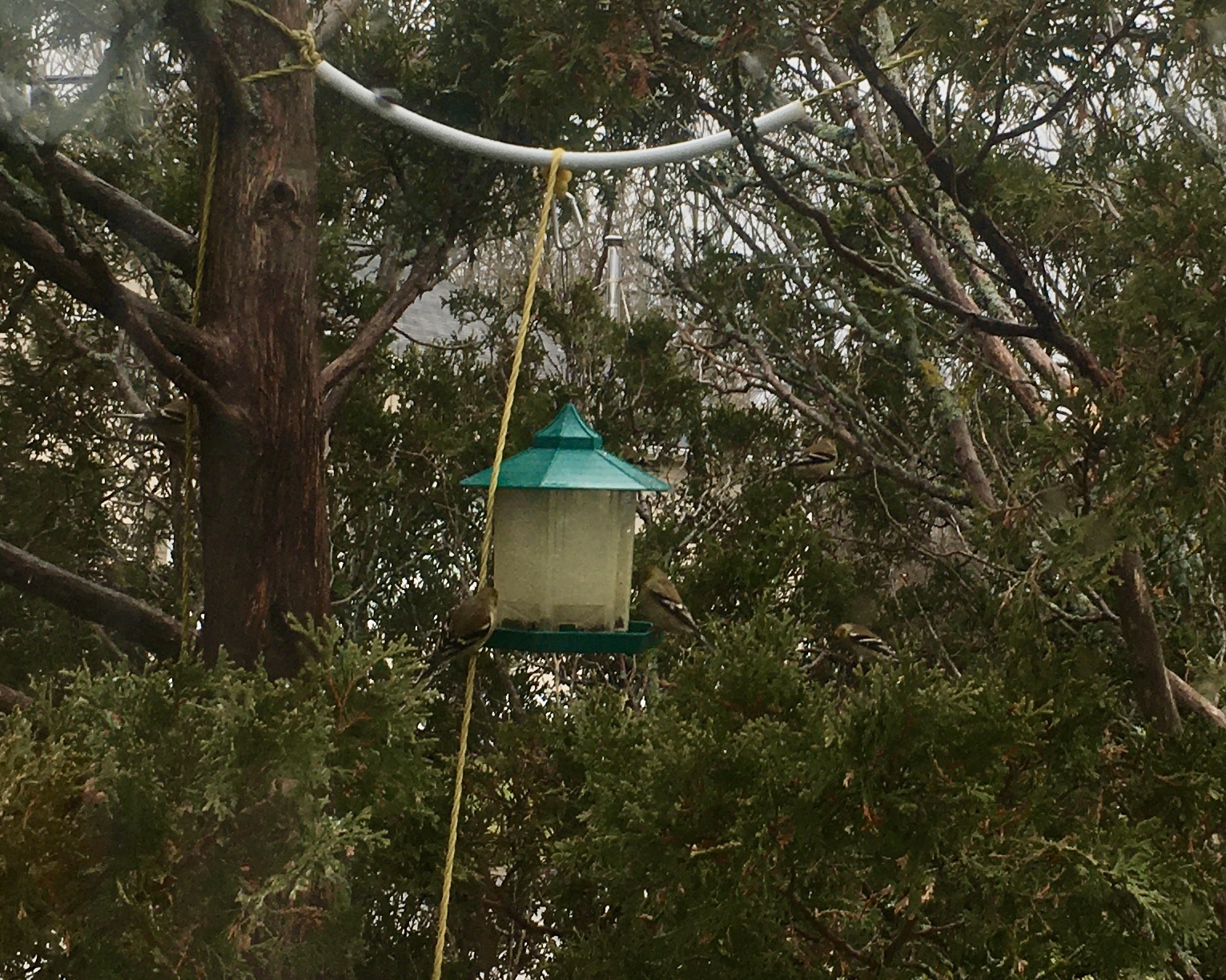
Somewhere out there, a young Goldfinch couple
I am tired of being sick, really tired of it.

A couple of days ago I noticed the 'Service Battery' notification on my laptop and started the process to do something about it. Among other things it involved running the battery down to nothing and leaving the laptop off overnight. Since I did not time things well, that meant a large part of one day and the following night. Now it's recharging but the 'Service Battery' notification is still there. Maybe it will go away when the battery is fully charged.

Having the laptop out of commission for most of the day I dug out a recently purchased but as yet unused Chromebook and started configuring that. Among other things it meant configuring my email and so I was more or less tied to email for the day. I have to say I am really tired of all my friends who crow about the amazing stuff they are doing in isolation. I feel like telling them all to just shut up.

One friend sent an email with pictures of the face mask she rigged up and I did kind of jump on her. Then I walked the dog and came back and wrote an apology. Haven't heard back. Think I'll stay away from email now that the Chromebook is setup and I'm done recalibrating the laptop battery.

The news is appalling. It's amazing how quickly the big issues of the day disappeared from the media, turns out they weren't so big after all. We're living in a century of huge life changing issues now. The pandemic is obvious, totally unexpected by all those predicters of future trends. Climate change was the one that was supposed to knock us off our feet, and in various localized ways that is happening. But the pandemic is everywhere, sudden, and having far reaching effects. It's not just people getting sick and dying, it's mass unemployment, markets crashing, politicians and medical experts taking over the airways, so on and so on. Maybe my parents' generation experienced something like this with the Great Depression followed by World War II, but that was kind of sequential, over a period of almost two decades. This is the whole nine yards all at once.

While writing this I am also corresponding with an old friend on the west coast who is a bit of a night owl. It's 8.30am here and 4.30am there. She has an online home business and she's an artist, her husband does kitchen installations and they live in a really nice coastal rural neighbourhood. Each home lot in the neighbourhood is over half an acre and surrounded by tall evergreen trees, the beach is a short hike away and there are lots of old logging road trails. So she's relatively well situated for self-isolation but she's living in a province that is pretty hard hit. She just told me a friend has Covid-19 and the friend's husband is in the ICU with it. You can live in paradise and still be vulnerable.

I phone another friend who lives in that same coastal rural neighbourhood and she has an underlying health condition in her lungs which will ultimately kill her. I won't be able to visit her again, so we talk on the phone regularly. I think I am suffering a bit of an oxygen deficit because after the call I am exhausted and out of air. Seems more tiring than walking the dog.

Anyway, she's a fairly devout Christian, if a bit eccentric about it, but she does firmly believe in an afterlife and feels sorry for people who don't. I keep quiet about my own beliefs, and I don't feel sorry for people who don't believe in an afterlife. Sometimes I think it would be nice to carry on in a brand new life after death, and sometimes I think, Oh give me a break, I'm done! Nighty-night.

She said she was pretty much reconciled with quitting this life except for one thing, she can't seem to get rid of her negative feelings about Trump. He really upsets her and she can get into quite a rant every time Trump says something obnoxious. I on the other hand think he is behaving according to expectation and only once did he upset me, after the Ukrainian flight was shot down over Iran and he said no American lives were lost. But that was personal (for me, not for him) and he didn't say anything unexpected.

In some ways he is a very stupid person and in other ways he is incredibly smart. I think that's what irritates people. I think a lot of what he says is deliberately done to keep folks off guard and he is wildly successful at that. Being ignored or treated as though he was inconsequential is the worst thing for him, so I try to maintain that attitude. He is consequential alright, but only because of his position, not because of any innate qualities. I try to explain my position to my friend but I don't think it helps, she still struggles with her perceived negativity. She wants to die in a state of benign acceptance and right now she can't do that.

Isolation does that to me too sometimes. I can spend days feeling benign acceptance and then suddenly descend into paranoia and upset. It's tough to claw your way back up again all by yourself. We're not really built for that.